For young parents · children aged 2 to 9
Why your child isn't overreacting
Tantrums, defiance, tears: understand what is behind them and know exactly what to say in that moment. 85 pages, 12 chapters, instant PDF.
Instant PDF · one payment, no subscription · coupon at checkout

- By Jess Li, a teacher with ten years of experience with children
- 85 pages · 12 chapters
- A clear overview of the research
- Concrete sentences for typical everyday situations

Sound familiar?
The mood flips in seconds. And nothing you say gets through.
Your child screams, drops to the floor, or shuts down completely. Tension rises in you, maybe shame or anger too. So you do what we all do: soothe, distract, get louder. And afterward the feeling lingers that none of it really helped.
That's not because you're doing something wrong, but because hardly anyone ever taught us how to handle big emotions. This book makes up for that.
The sentences we all know and that rarely help
- “That's not such a big deal.”
- “Stop crying now.”
- “Come on, let's do something fun.”
- “You should really be able to handle this.”
The approach
Meet feelings instead of stopping them
When you understand why your child reacts this way, your view shifts, and so does your response. No rigid rules, just relatable sentences and strategies for real everyday moments.
What we often say
- “Stop it right now.”
- “That's enough.”
- “Pull yourself together.”
What lands
- “I can see you're angry.”
- “I'm here.”
- “That was hard for you just now.”
The difference isn't a trick, it's a stance. And it can be learned, sentence by sentence.
What's inside
12 chapters, from “Why?” to “What do I say now?”
First understand, then make sense of it, then support. It all stays close to everyday life with children.
- 01Chapters 2 and 4
Understand what is behind it
What emotional intelligence means and how feelings develop in children, without jargon.
- 02Chapter 3
What studies suggest
A clear overview of findings from practice and research.
- 03Chapter 5
Clearing up misunderstandings
Which well-meant sentences and reactions rarely help, and what lands instead.
- 04Chapters 6 and 7
Sentences that land
Naming feelings, holding limits and concrete strategies for everyday life.
- 05Chapter 8
Anger, defiance and tears
What is behind the outburst and what helps in that moment.
- 06Chapters 10 and 11
Your role and everyday life
Why your behaviour matters, plus examples such as the supermarket tantrum, sharing and conflict between children.
All chapters at a glance
- 01Introduction
- 02Understanding emotional intelligence
- 03What studies suggest
- 04Understanding children's emotional development
- 05The most common misunderstandings about feelings
- 06Meeting feelings instead of stopping them
- 07Concrete strategies for everyday life
- 08Understanding anger, defiance and tears
- 09Actively nurturing emotional intelligence
- 10The role of adults
- 11Understanding and supporting everyday situations
- 12Development takes time
A look inside
Three real pages from the guide.
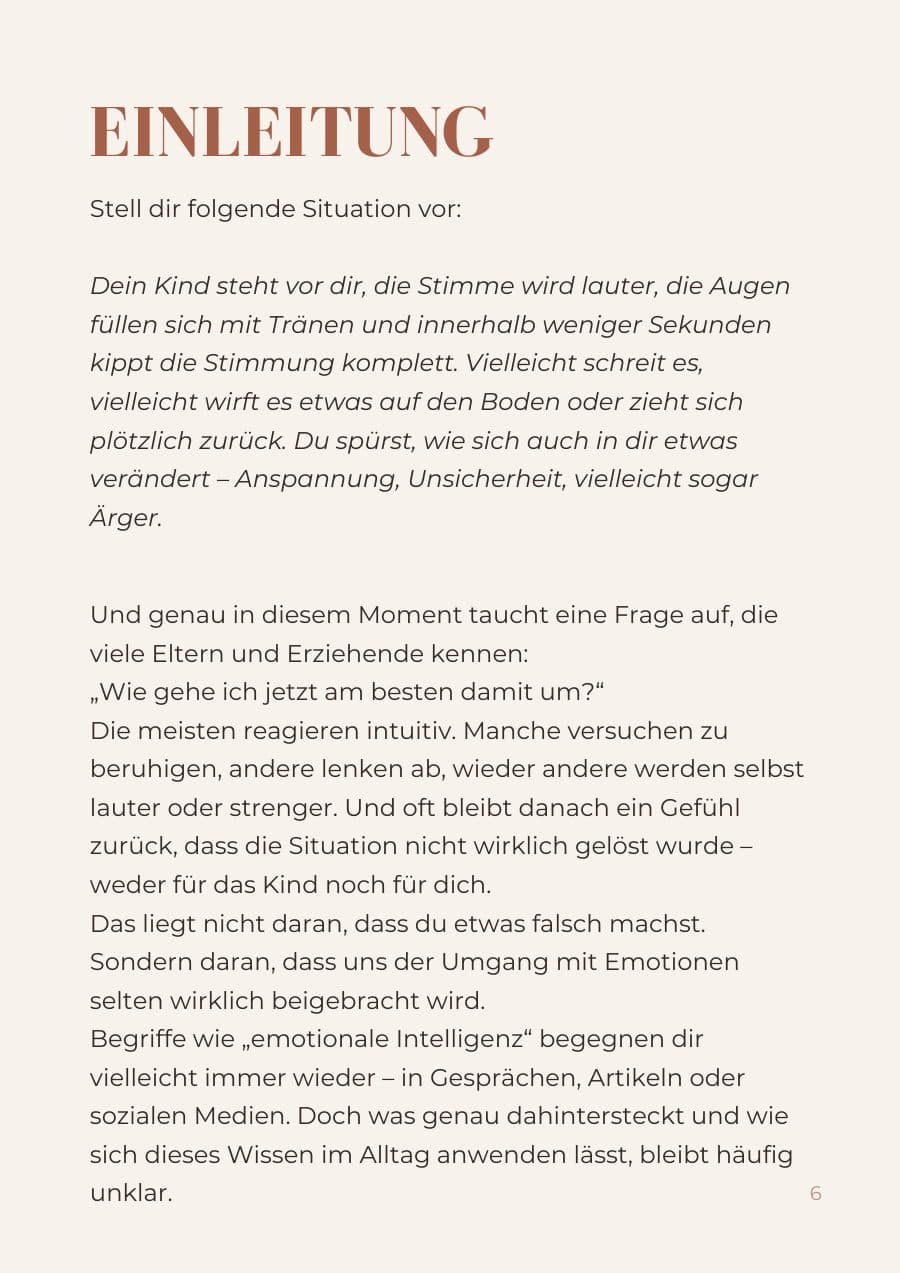
Introduction, page 6 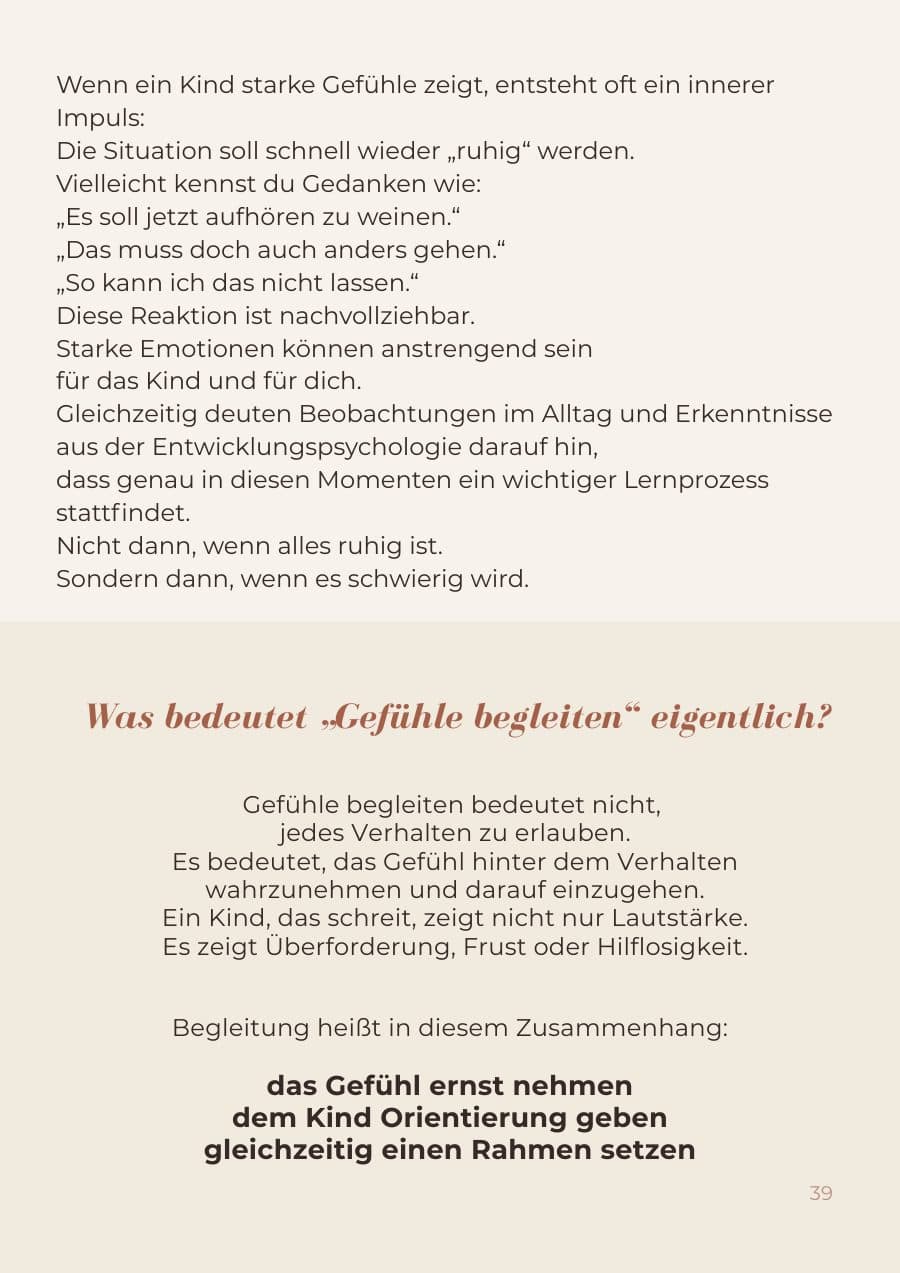
Chapter 6: Meeting feelings instead of stopping them, page 39 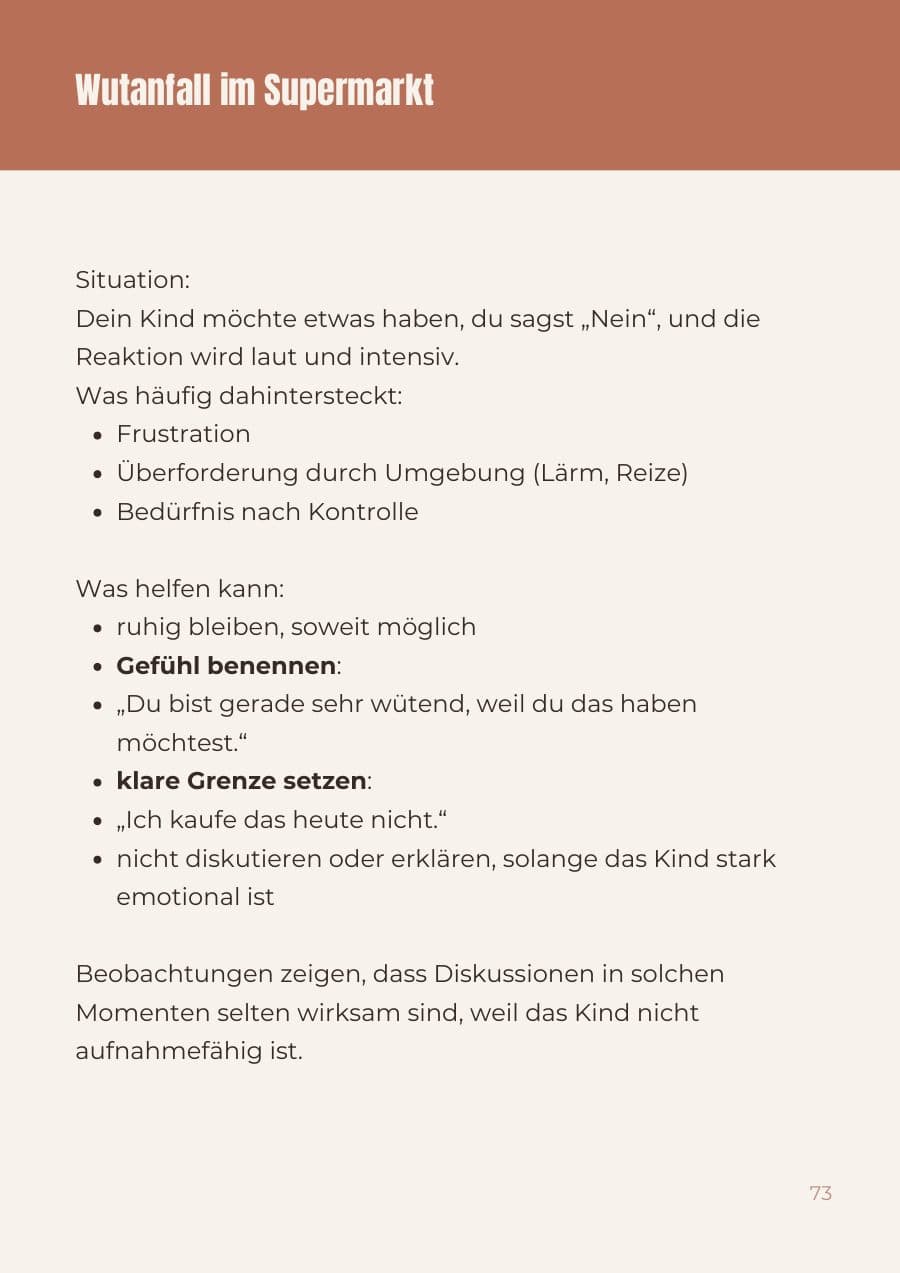
Chapter 11: Everyday situations, page 73
Maybe you're thinking …
Honest answers to the most common doubts
- “Isn't this too permissive?”
- No. Limits stay in place (“I'm not buying that today.”). You acknowledge the feeling, not every behaviour.
- “I don't have time to read.”
- You don't have to read it front to back. The everyday situations in chapter 11 each stand on their own, so you can look them up, even on your phone.
- “I can find this for free online.”
- A lot of it, yes, but scattered and without a thread. Here it is in order, in one place, readable without internet.
- “Will this work for my child?”
- There is no guarantee and no miracle method, because children differ. The guide gives you orientation instead of rigid rules, which you can adapt to your child.
- “Is this a substitute for therapy?”
- No. It is an everyday guide, not a diagnosis or therapy. If you are worried about your child's development, talk to your paediatrician.
From the book
„That's not because you're doing something wrong. It's because we are rarely really taught how to deal with emotions.“
„Not in the sense of blame. In the sense of influence.“
„Sharing is a skill that develops, not something that can be expected right away.“
Passages from the e-book, translated from the German original
Any questions?
Frequently asked questions
What age is the book for?
The examples and sentences are written for children of about 2 to 9. The attitude behind them also fits beyond that.
What exactly do I get?
An e-book as a PDF with 85 pages and 12 chapters. You can read it on a phone, tablet, e-reader and computer.
How do I get the e-book?
Right after payment you are taken to the thank-you page and can download the PDF immediately. It is best to save it to your device straight away.
Is this scientific?
The book summarises findings from practice and research in plain language. It is an everyday guide, not a diagnosis, not therapy and not a substitute for medical or therapeutic advice.
Can I withdraw from the purchase?
For digital content with immediate access: at checkout you expressly agree that we deliver right away. Your right of withdrawal then expires as soon as the download begins. More on the “Returns” page.
How can I pay?
You pay securely by card through Stripe. The price is a final price including VAT. You enter a coupon at checkout.
How was the book made?
The text is by Jess Li. Some illustrations are AI-generated, the cover is a real photo, and the editing was partly AI-assisted. This is also stated on the copyright page in the book.
Is there a printed edition?
Paperback and Kindle editions are planned. We'll let you know here as soon as they are ready.
Your e-book
React calmer, starting with the next tantrum.
One-time purchase. Instantly available. Yours forever.
- 85 pages of practical guidance
- 12 chapters of everyday strategies
- Concrete sentences for hard moments
- Readable on phone, tablet & e-reader
- Pay once, keep it forever
- 1Click “Pay securely” — you'll land in the protected Stripe checkout.
- 2Right after payment you're redirected to the thank-you page with your download.
- 3Save the PDF to your device straight away, so you always have it with you.
One-time purchase
one-time · no subscription
Secure & GDPR-compliant via Stripe
After purchase you're automatically redirected to the thank-you page with your PDF download.

About the author
Why I wrote this book
I have been a teacher for ten years. I have seen many moments in which a child was overwhelmed and the adults around them did not know what would help. I know the moment when everyone is waiting for a solution.
What I noticed again and again: it is rarely the child's fault. And it is never because adults don't mean well. Hardly anyone ever taught us how to handle big feelings.
I'm about to become a mum myself. That made it all the more important to write down what I have learned: clearly, without a raised finger, and with sentences you can try right away.
I hope that next time you take a deep breath, name a feeling, and notice something ease.
Jess
Jess Li · Teacher and founder of little rootlings
For today. And for what's coming.
Thoughts, knowledge and new guides on childhood, development and the future. In your inbox only when we genuinely have something to share.